John Kamp
January 2024
Eminence: Distinguished superiority, elevated rank as compared with others. (Oxford English Dictionary)
It’s indisputable that Auke Tellegen has attained eminence in the fields of personality psychology and psychological measurement. The numerous awards listed on the Biography page of this site provide public evidence of that. Those of us who were fortunate to be his student and/or collaborator have been touched directly by that eminence.
But Auke is far from alone among the Tellegen clan in attaining greatness in his or her field. In this document, I summarize the achievements of eight of Auke’s relatives, a remarkable ensemble. Dating back as far as three generations prior to Auke, all but one bear the surname Tellegen. The eight are grouped according to their field of endeavor. A ninth relation included at the end, Lou Tellegen, could not be called eminent, but is so terribly colorful as to defy exclusion.
The information contained herein is drawn from internet searches and conversations with Auke.
The Law
Auke’s paternal great-grandfather Bernadus D.H. Tellegen (1823-1885) was professor of constitutional law and international law at the University of Groningen, where he achieved the rank of Rector Magnificus. A supporter of women’s rights, he was an intellectual leader of Dutch liberalism of the 19th century. He also served on the Provincial Council of Groningen.
Son of Bernardus Tellegen, Auke’s grandfather, Antonius O.H. Tellegen (1856-1920) was a judge who rose to the rank of Court President. He several times refused appointment to the Dutch Supreme Court, saying, according to Auke, that “he thought it would be boring.”
Auke’s father, son of Antonius Tellegen, also worked in the law, as well as in public service; he is discussed in a later section.
Public Service
A brother of Antonius Tellegen, and therefore Auke’s great-uncle, Jan W.C. Tellegen (1859-1921) was one of Amsterdam’s most effective and important citizens. He began his career as a structural/civil engineer, and in that capacity directed several major construction (e.g., railway) projects. Beginning in 1890, he served a decade as director of municipal works for the city of Arnhem, where he implemented a number of important urban improvement projects.
In 1900, he was named director of Amsterdam’s Building and Housing Supervision Department. A crusader for decent, modestly priced housing for Amsterdam’s working class (so-called “people’s houses”), Tellegen changed the face of housing in Amsterdam, even though it meant butting heads with builders who railed against the restrictions that he persuaded the city council to adopt. Then, from 1915 until his death in 1921, he served a distinguished tenure as mayor of Amsterdam. In recognition of his accomplishments, Jan W.C. Tellegen has streets named after him in both Amsterdam (Burgemeester Tellegenstraat, or “Mayor Tellegen Street”) and Arnhem. He is also honored with several monuments and remembrances in the two cities.
Jan Tellegen’s daughter Marie Anne Tellegen (1893-1976) filled several important roles during her lifetime, namely, feminist, Nazi resistance fighter, and government official. While studying law in Utrecht, she argued for expansion of rights for female factory workers and proclaimed in the student magazine that “a social reform had to be carried out quickly and vigorously.” She later founded the Committee for the Defense of Freedom of Work for Women and served on the board of the Association of Women’s Interests and Equal Citizenship.
During the Nazi occupation of the Netherlands (1940-1945) she participated in the hiding of Jews, helped distribute the illegal magazine Vrij Nederland (Free Netherlands), and joined the leadership of the National Committee of Resistance. After the war she was appointed the first female Director of the Queen’s Cabinet, a liaison between the Dutch queen and the elected government. She served two queens (Wilhelmina and Juliana) during her 14 years in this post, and continued as informal counselor to the royal family after retiring.
Science and Technology
Bernard Tellegen (1900-1990), a cousin of Auke’s father, was an electrical engineer and inventor. After obtaining a Masters degree in electrical engineering, he worked for a private laboratory and later became an adjunct professor of circuit theory at the University of Delft. A prolific inventor, he held 41 US patents. He is best known as the author of Tellegen’s Theorem (1952), a powerful and still important law in electrical network analysis. In 1963 he was elected to the Royal Netherlands Academy of Arts and Sciences, and in 1973 he won the Institute of Electrical and Electronics Engineers (IEEE) Edison Medal “for a creative career of significant achievement in electrical circuit theory.”
Auke’s paternal grandmother Aurelia was a member of the wealthy, prominent, Tetrode family. Hugo Tetrode (1895-1931) achieved eminence during his relatively short career as a theoretical physicist, contributing to statistical physics, early quantum theory, and quantum mechanics. He published his first research paper at the age of 17; later that year he developed an important and enduring equation in quantum mechanics. After gaining recognition so young, he corresponded with Einstein, Hendrik Lorenz, and Paul Ehrenfest and wrote several more influential papers. Characterized as reclusive, it is said that once when Einstein and Ehrenfest tried to visit him at his home is Amsterdam, his maid sent them away, saying “Sir is not receiving guests.” Hugo Tetrode died from tuberculosis at age 35.
Literature
Toon Tellegen (1941-present), a second cousin of Auke’s, is a highly acclaimed Dutch author. His early career was spent as a physician in Amsterdam. He then turned to writing, mainly for adults. In the mid-1980s he switched to children’s books, in which he has achieved enormous success. He has also published more than 20 volumes of poetry, along with other works. He has accumulated a lengthy list of literary prizes, and in 2006 was a finalist for the international Hans Christian Andersen award for children’s literature.
Special Recognition: Auke’s Father & Mother
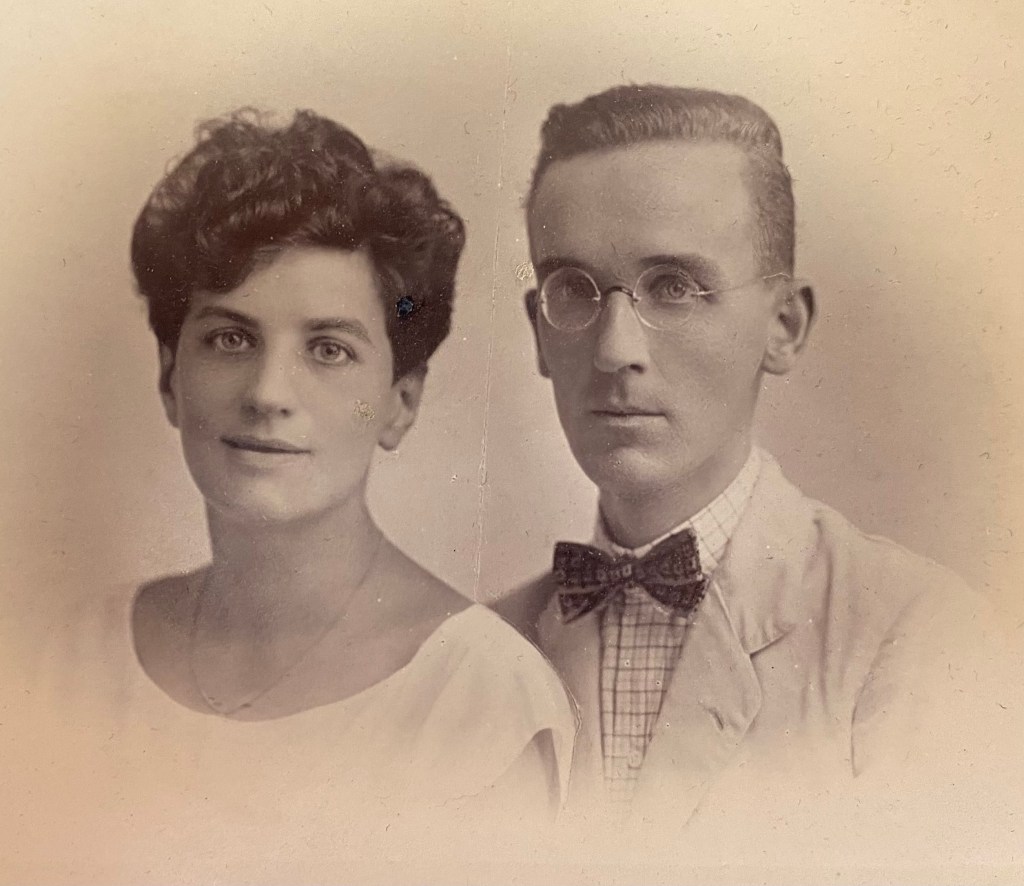
Pieter Helenus Wigbold Floris Tellegen (1895-1977) studied law and then was deputy public prosecutor in the Dutch East Indies, where Auke was born on July 16, 1930. After returning to the Netherlands, he was in 1936 appointed mayor of Terneuzen, a port city in the southwest corner of the country with a current population of approximately 55,000. After the Nazi occupation of 1940, Pieter Tellegen and his wife Veronica began harboring Jews in their home; this lasted almost two years until they decided to end it after a close call incident with the Germans. In 1941, Pieter was removed from his home and sent to a “hostage camp” along with other Dutch civic leaders. Employing a brutal method of controlling the populace, the Nazis would punish citizen acts of resistence by choosing camp confinees at random to be executed. Fortunately, Auke’s father survived the camp through the war’s end in 1945, when he was restored as Terneuzen’s mayor. He retired from the post in 1960.
Auke’s mother Veronica and Pieter met and married during his time as a prosecutor in Indonesia. Characterized by Auke as a fearless Friesan, she exhibited great courage during the wartime years in the Netherlands. She took sole responsibility for hiding Jews in the family home after Pieter was sent to the hostage camp. She risked her life riding the train to visit him there regularly at a time when trains were being bombed by the Allies. She kept the family of four (including Auke and sister Aurelia) together during this time of fear and turmoil.
The Actor
Both famous and infamous, Lou Tellegen (1883-1934), a distant relative of Auke’s, achieved celebrity as a stage and film actor, as well as a notorius playboy. Making his stage debut in Amsterdam in 1903, he built a reputation that eventually brought him to Paris, where he co-starred in several roles with legendary French actress Sarah Bernhardt. He was also romantically involved with Bernhardt, though she was 37 years his senior.
In 1910 he began a series of leading man roles in silent films, the first few alongside Bernhardt in France, then in Hollywood, where he became known as one of the best-looking actors on screen. Another of his famous co-stars was actress and opera mega-star Geraldine Farrar, whom he would marry in 1916. However, the marriage was scandalous and ended in divorce, reportedly because of his numerous affairs. In all, Lou Tellegen married four times—he titled his 1931 autobiography Women Have Been Kind.
By the early 1930s, however, his popularity had declined, and he had trouble securing acting work. (Perhaps the extensive 1930 plastic surgery to repair burns to his face that he sustained when he fell asleep smoking didn’t turn out too well?) He was also deeply in debt, filed for bankruptcy, and grew despondent. In 1934, at age 50, he locked himself in a bathroom of a Hollywood mansion owned by a female friend, then shaved and powdered his face. Standing in front of a full-length mirror, he stabbed himself in the heart seven times with a pair of sewing scissors. Some accounts claim he had surrounded himself with newspaper clippings of his career at the time of his suicide. In a posthumous stabbing blow, Geraldine Ferrar, when given the news replied, “Why should that interest me?” Touché.
Conclusion
Hopefully you’ve enjoyed these sketches of a (mostly) distinguished and thoroughy fascinating Dutch family that Auke Tellegen calls his own. I’d love to see your comments (see below). In a kind of “Tellegen Rorschach,” you might even say which of these individuals is your personal favorite! Aside from Auke, of course.
 Auke Tellegen
What a fascinating family! My favorite is Auke’s mother, Veronica. A true heroine from whom Auke likely inherited his own fierceness.
LikeLike
How to choose just one favorite when one refuses Supreme Court duties out of a fear of boredom and another tells Einstein to kick rocks? This is such a fascinating summary and enlightening to better understand Auke’s eminence. Thanks, John!
LikeLike
Thank you for your comment, Danielle! -John
LikeLike
Dear John Kamp,
Thank you for writing about “ the Tellegens”
The Tellegen I like ( love) most is the mother of Auke. She was my grandmothet . I am named after her. What you wrote about her, was what my mother often had told to me. She was the sister of Auke, Aurelia.
With love, Veronica Sikkel,Holland
LikeLiked by 1 person
I’m glad that you liked my essay about some of your ancestors. I had the pleasure of meeting your mother Aurelia one time at a dinner in San Diego, California. Although it was a brief encounter, she seemed to have much in common with her mother Veronica, who is your grandmother and namesake. -John Kamp
LikeLike
My favorite eminent Tellegen is Auke, mother, Veronica, the fearless Friesan. The apple does not fall from the tree!!
LikeLike
What a great read! Thanks for this, John. If I could meet only one of these people, I think I would choose Marie Anne Tellegen (Auke’s 2nd cousin?). It sounds like she was a mover and shaker and a caring person. No wonder she ended up advising 2 queens!
LikeLike
John, I am so very grateful for this wonderful summary of our family history. You are amazing and my father so values your friendship. Warmest regards, Gwen
LikeLike